




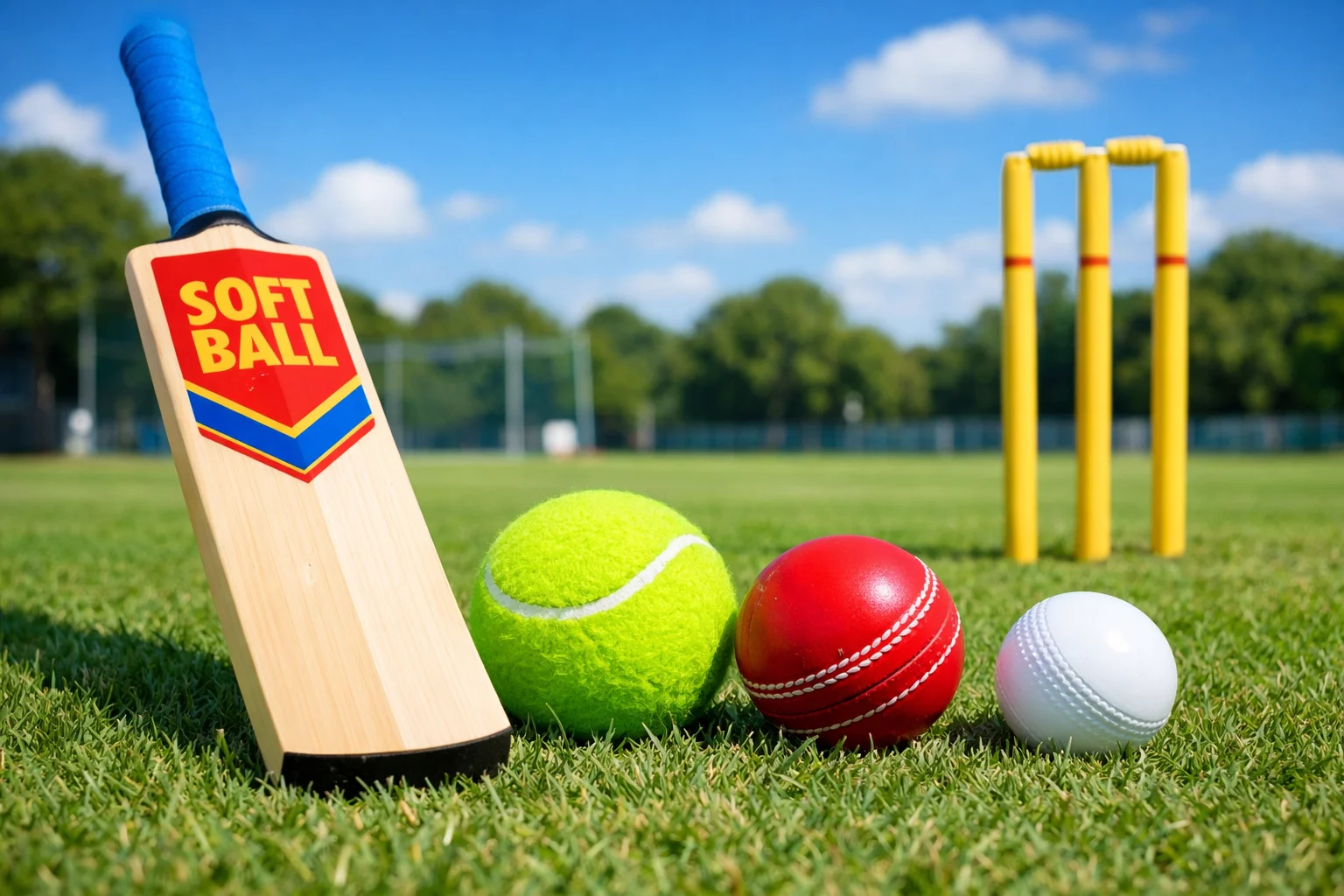
Many players and parents arrive at this question from a similar situation: cricket is being played regularly, a bat is needed, and it is not clear whether a soft ball bat is the correct type or simply a lower cost option compared to a proper cricket bat. This article covers what soft ball cricket bats are made to do, how they differ from hard ball bats in terms of construction, what the size numbers mean for different players, and the situations where these bats are not the right choice. It does not cover batting technique, training methods, or hard ball cricket equipment. If you are trying to understand whether a soft ball cricket bat suits how you play, this article covers that.
How Soft Ball Cricket Bats Are Designed Differently from Hard Ball Bats
The clearest difference is the blade material. Soft ball cricket bats are mostly made from poplar wood or lower grade willow, not the seasoned English or Kashmir willow that hard ball bats use. This is not because the manufacturing is cut short. It is because poplar and lower grade willow suit the weight and force of a tennis ball or tape ball, which contacts the blade with much less impact than a leather cricket ball does.
The blade shape is also different. Soft ball bats have a flatter face and the edges are not as pronounced. Hard ball bats are made with a thick spine and raised edges because a leather ball hitting the blade needs the force to spread across a wider area. That kind of shaping is not needed for soft ball play. Adding it would only make the bat heavier without giving the player any real advantage in that format.
The handle on a soft ball bat is generally shorter and thinner than on a hard ball bat. Hard ball bat handles are built with layers of cane and rubber to absorb the shock that comes from a leather ball hitting the blade repeatedly. For soft ball formats, that level of handle construction is not needed. The grip on these bats is also thinner and lighter, which is suitable because a tennis ball or tape ball does not send the same kind of vibration through the handle that a leather ball does.
What the Different Size Numbers Actually Mean
Soft ball cricket bats are available from Size 0 to Size 5. Each size up means the bat is longer overall, the blade is wider, the handle is longer, and the total weight is higher. The difference between sizes is not small. A Size 0 and a Size 5 feel and behave very differently when held and swung. Using a size that does not suit the player makes the bat harder to control, and this is true regardless of how experienced the player is.
Size 0 and Size 1 are made for younger children, mostly in the five to seven year age range. The length is short enough for a small player to hold the bat in the correct position without the hands sitting too close to the blade. The weight is low enough that a child can swing fully without losing balance or grip during the shot.
Size 2 and Size 3 are generally for children aged eight to twelve. These are the sizes used most often in school cricket and backyard games among children of that age. The blade is wide enough to make it a little easier to make contact, and the handle length gives the player space to adjust grip position as they get older.
Size 4 is a transition size for players roughly between twelve and fifteen years old. It is close to full adult length but the weight is a little lower than a Size 5, which makes it more manageable for players who have not yet reached full physical development.
Size 5 is the adult size. It has full blade dimensions and full handle length. If a younger player uses a Size 5 before they are physically ready for it, they will have difficulty with bat speed and timing. This is not a skill problem. It is simply because the bat is too heavy for them to swing correctly at that stage.
The Types of Games These Bats Are Built For
Soft ball cricket bats are made for cricket played with a tennis ball or tape ball instead of a leather cricket ball. In Sri Lanka this includes backyard games, street cricket on open ground, school matches played without hard ball rules, and organised tape ball tournaments that follow their own format and conditions.
These formats have certain things in common. The ball is lighter, it bounces differently from a leather ball, and the game does not need protective equipment or a prepared pitch the way hard ball cricket does. The bat is built for those conditions. It handles the weight and pace of a soft ball consistently across regular use and does not need the same kind of upkeep that a hard ball bat requires.
These games are also played much more often than formal cricket matches in most households. A soft ball bat in Sri Lanka will typically be used several times in a week, across different surfaces and in different conditions. The way these bats are constructed reflects that pattern. They are made for frequent informal play, not for occasional use on a prepared cricket ground.
Common Mistakes Players Make When Using These Bats
A common mistake is choosing a size based on how the bat looks when the player stands next to it, rather than how it feels when they actually swing it. A bat that reaches the right height when held upright does not always feel right in motion. If the bat is too heavy for the player, they will tend to rush the swing to get the bat through on time, and this affects timing badly. This situation comes up often when an adult buys a bat for a child and chooses a larger size so the child can use it for longer. A bat that is the correct size now will be used more and will help the player develop better habits than one they have to grow into over the next year or two.
Keeping the bat in damp or outdoor conditions is another mistake that reduces the lifespan of these bats more quickly than regular play does. The blade on a soft ball bat is made from lighter wood that takes in moisture more easily than the timber used in hard ball bats. Leaving the bat in a bag left outside, in a shed with poor airflow, or outdoors after an evening game will cause the blade to absorb moisture gradually. Over time this leads to the blade swelling, cracking, or splitting along the grain.
Using the bat frequently on hard surfaces like concrete or tar also causes the blade face and edges to wear faster than normal. The blade on these bats is not built for the sharp low bounce that a tape ball produces when it hits a hard surface repeatedly over many sessions. Players who use these bats mainly on concrete will notice the edges wearing down earlier than they would if the bat was used on softer ground.
Many players also leave the grip too long before replacing it. A grip that has worn smooth reduces control during the swing, and this is felt most by younger players who do not have enough hand strength to hold on firmly when the grip is slippery. Grip replacements are not expensive and are easy to find locally. Changing the grip when it starts to wear is one of the more straightforward ways to keep the bat usable for longer.
When a Soft Ball Cricket Bat May Not Fit Your Needs
If a player has moved into a club that plays with a leather cricket ball, a soft ball bat is not the right equipment for that setting. The blade is not constructed to handle the repeated impact of a hard ball and it will wear out quickly under those conditions. Apart from the wear, the way a soft ball bat responds during hard ball play will not give the player accurate feedback on what they are doing with the bat. A hard ball bat is the correct equipment for that format and the two types do not substitute for each other.
A soft ball bat is also not suitable for a junior player whose coach or development programme requires equipment made to specific construction standards. Some school programmes and junior cricket setups define requirements for bat weight, blade thickness, and handle specifications as part of how they run training. A soft ball bat will not meet those requirements, regardless of what size it is or how well it fits the player in terms of length and weight.
For anyone buying a bat with the intention of supporting a child who plans to move into competitive hard ball cricket over the next few years, a soft ball bat does not carry over into that context. It works well for the format it is made for, but it is not preparation for hard ball cricket equipment.
How Soft Ball Bats Fit Within the Wider Cricket Bat Range
Soft ball cricket bats are one type within a broader range of cricket equipment, and they are built specifically for the formats described in this article. The size range from Size 0 to Size 5 means there is a suitable option for most players, from young children who are just starting out to adults who play regular tennis ball or tape ball cricket. Other bat types exist for other formats and playing levels, and each type is constructed around what that format requires from the equipment. Deciding on the correct type first is what makes choosing the right size a straightforward process from there.