

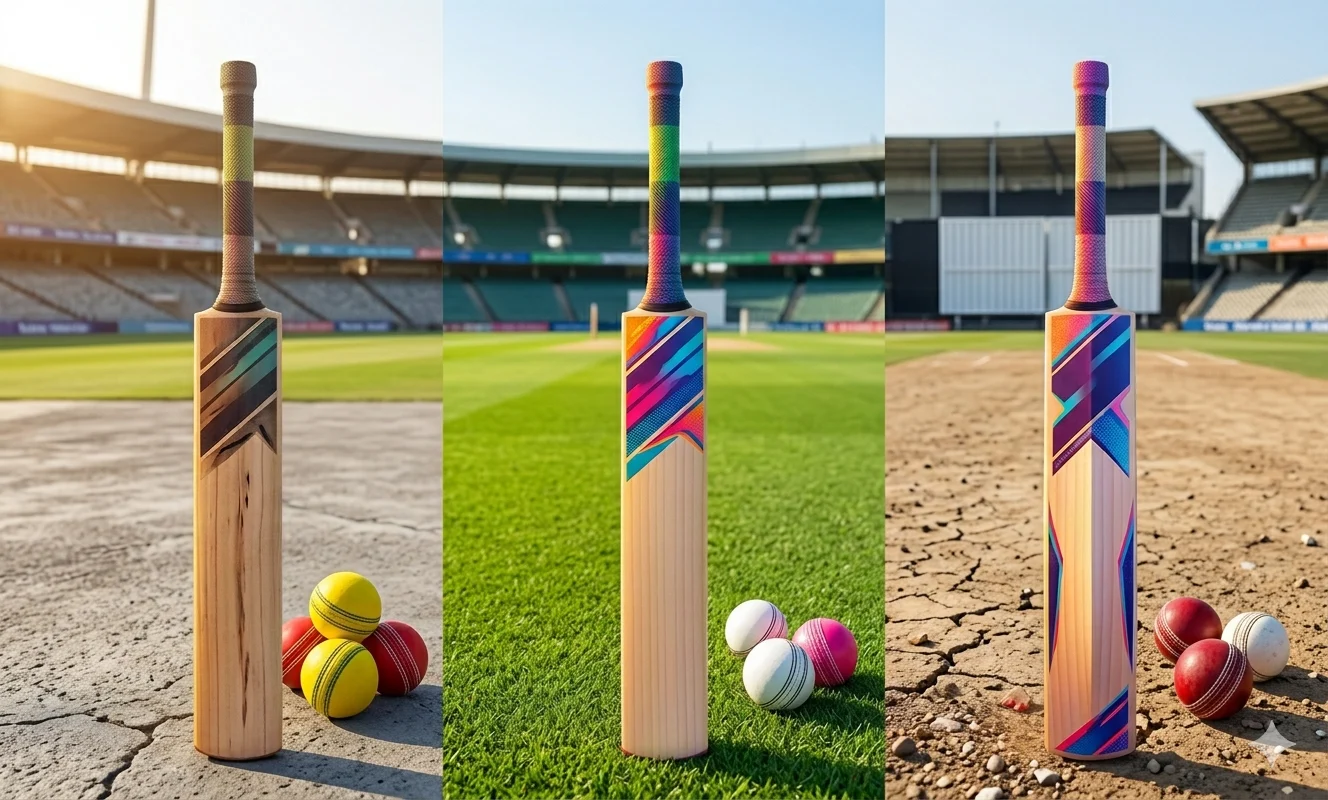
Many players use the same bat across different surfaces without thinking much about it, until the bat starts showing wear in places that do not make sense, or until the bat stops feeling right during play. A player who uses their bat on concrete during the week and on matting or turf on weekends, or a parent buying a replacement bat for a child who plays in more than one setting, may not have considered that the playing surface is relevant to which bat construction holds up over time. This article covers how street, turf, and matting surfaces each affect the bat during play and what construction features are relevant to each. It does not cover technique, pitch preparation, or surface installation.
How Street and Concrete Surfaces Affect the Bat During Play
Concrete and tar are the surfaces where most informal cricket in Sri Lanka is played. A tennis ball or tape ball bouncing on a hard surface comes up quickly and with more pace than it does on softer ground. The contact point on the blade during this kind of play tends to be lower on the face, because the ball stays low after the bounce and reaches the bat before it has risen very far.
This contact pattern puts repeated stress on the lower portion of the blade and on the toe of the bat. A bat used mainly on concrete will show wear at the toe and along the lower edges before the rest of the blade shows any real damage. This is normal for that surface type, but it means the toe and lower blade construction are more relevant to how long the bat lasts than they would be on a softer surface.
A bat with a thicker toe and more wood distributed toward the lower portion of the blade will hold up better under regular concrete use than one where the construction is concentrated higher up. Players who use their bat almost entirely on concrete and do not consider this often find the toe splitting or the lower edges chipping earlier than they expected. The surface is the reason for this, not a fault in the bat itself.
How Turf Surfaces Change the Contact Pattern on the Blade
On a grass or turf surface, a tennis ball or tape ball bounces more slowly and rises higher after pitching compared to concrete. The contact point on the blade during turf play tends to sit higher on the face, because the ball has more time to rise before it reaches the bat.
A bat with a sweet spot positioned higher on the blade suits turf play more closely than one where the sweet spot is near the toe. If a player uses a bat constructed for low surface contact on a turf surface regularly, the area of the blade where the ball most often makes contact will not be the area where the construction is at its thickest and most solid.
Turf surfaces also produce less physical stress on the toe and lower blade than concrete does. Players who use their bat only on turf will generally find the blade wears more evenly over time. The bat does not take concentrated impact from the surface itself the way it does on concrete, and this affects how the wear pattern develops across the blade over several months of use.
How Matting Surfaces Sit Between the Two and What That Means for the Bat
Matting surfaces produce a bounce that is more consistent than concrete but faster than turf. The ball comes up at a more predictable angle, and the pace off the surface is higher than on grass but without the hard sharp bounce that concrete produces. The contact point on the blade during matting play sits between the lower contact of concrete and the higher contact of turf.
A bat used regularly on matting will show wear more evenly across the lower and middle portions of the blade. The toe does not take the same concentrated stress as it does on concrete, but the middle and lower blade areas are still in regular contact with the ball at a pace that is higher than turf play produces.
The difference in bat suitability between matting and concrete is smaller than the difference between turf and concrete. A bat constructed for concrete use, with wood concentrated toward the lower blade, will suit matting play reasonably well. A bat constructed for higher contact, with the sweet spot sitting in the middle or upper blade, will not suit matting play as closely.
What Happens When One Bat Is Used Across All Three Surfaces
Many players in Sri Lanka use a single bat across street games, school matches on matting, and occasional turf play. This is a practical reality for most players and it is worth understanding what it means for the bat over time.
When a bat is used across all three surface types, the wear pattern on the blade becomes uneven. The toe takes stress from concrete use. The lower and middle blade takes contact from matting. The higher blade area comes into contact more during turf play. All three wear patterns are happening to the same bat, and the construction of the bat was designed for one primary contact pattern, not three.
A player who notices wear appearing in several different areas of the blade at the same time is often seeing the result of mixed surface use rather than a fault in the bat. The bat will also reach the end of its usable life sooner than one used consistently on a single surface, because no single area of the blade gets time to recover between sessions. This is useful information for setting realistic expectations about replacement timing, particularly for players who use their bat across all three surfaces every week.
Situations Where the Surface Match May Not Be the Main Concern
For a younger player who is still in the early stages of learning the game, the size and weight of the bat are more important than surface suitability. A child using a bat that is the correct size and weight for their physical development will get more practical use from the equipment than one using a surface-matched bat that is too heavy or too long to control properly. At that stage, the volume of play is usually not high enough for surface wear patterns to become a real issue within one or two seasons.
A second situation is a player who plays infrequently across all surfaces. If the bat is used once or twice a week at most and the sessions are short, wear from surface contact will accumulate slowly regardless of which surface is involved. For this type of player, surface matching is a lower priority than choosing a bat that is the correct size and profile. The surface question becomes more relevant as the frequency and duration of play increases, not before that point.
How Surface Considerations Fit Within the Soft Ball Cricket Bat Range
Surface suitability is one of several construction variables that are relevant when choosing from the range of soft ball bats available. Size gives the length and handle dimensions. Profile gives the blade shape and sweet spot position. Surface suitability connects to both of these through the construction of the toe, the distribution of wood across the blade, and where the sweet spot sits. A player who only looks at size when choosing a bat is missing information that affects how well the construction matches their actual playing conditions. All three variables together give a more complete picture of which bat suits a specific player in a specific setting.