





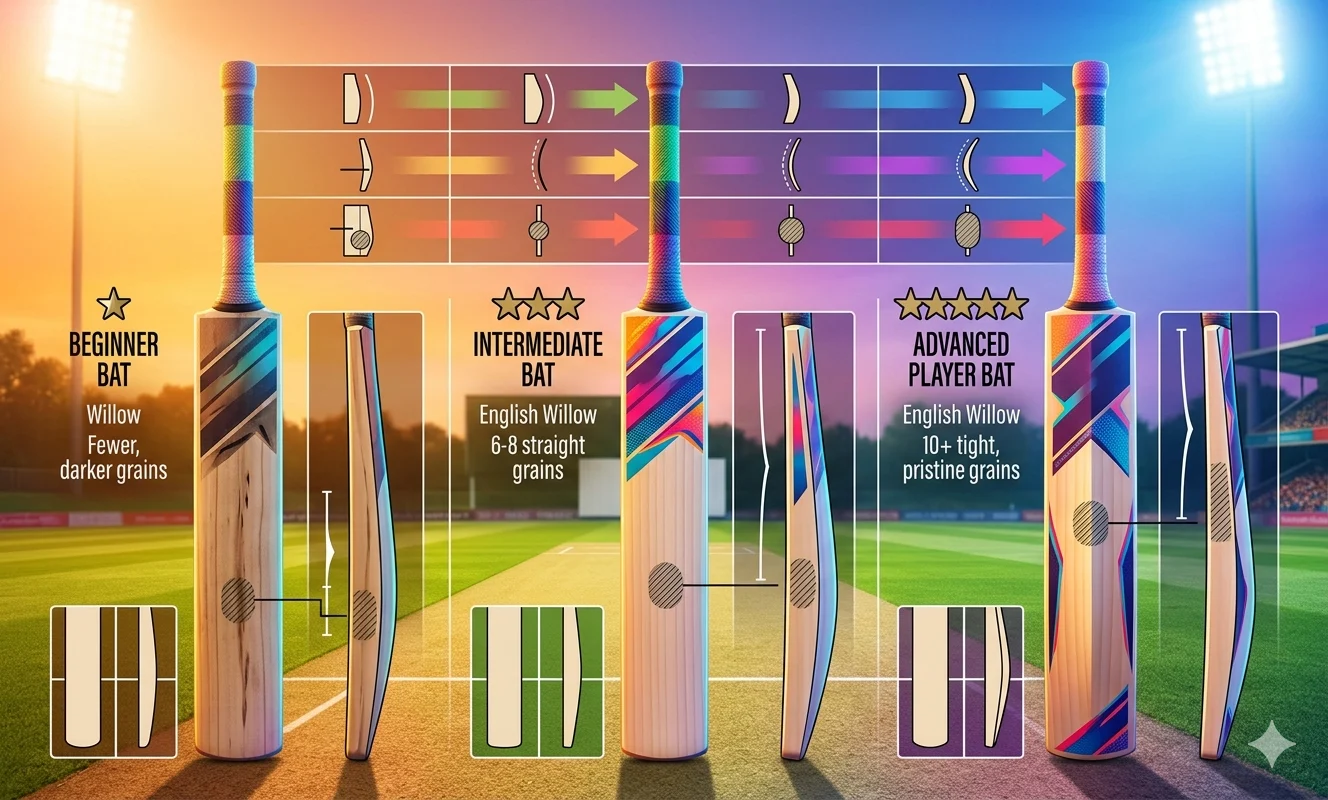
Players who have been using the same bat for some time, or parents who are buying a second bat for a child who has finished using their first one, often start to wonder whether the shape of the blade makes a real difference to how the bat works. This article covers what bat profile and sweet spot mean as physical features of the bat construction, how these features differ across bat types, and how they connect to the way different players use a bat during play. It does not cover batting technique, skill development, or performance outcomes. Knowing what these construction features mean helps in choosing a bat that suits the player who will use it, rather than one that only looks correct or measures the right length.
What Bat Profile Actually Refers to in Construction Terms
Bat profile is the physical shape of the blade when it is viewed from the side. It includes the thickness of the blade at different points along its length, the height of the spine that runs down the back of the blade, the width of the edges on both sides, and how all of these measurements are distributed from the top of the blade down to the toe.
A bat with a high spine has more wood concentrated along the centre of the back of the blade. A bat with a low spine has that wood spread more evenly across a wider area. The edge width refers to how thick the sides of the blade are at their widest point. When the edges are wider, more wood is present toward the outer areas of the blade face.
These are construction characteristics and not quality indicators. A flat profile with narrow edges is not a lower quality bat than one with a pronounced spine and wide edges. They are different constructions made for different types of use and different types of players. The profile of a bat is decided during the manufacturing process based on the type of player and the type of play the bat is intended for. It does not change with use and it cannot be adjusted after the bat has been made.
Where the Sweet Spot Sits and Why Its Position Varies Between Bats
The sweet spot is a specific area on the face of the blade where the construction of the bat is at its thickest and most solid. When the ball contacts this area, the blade does not flex as much as it does in other parts of the face. The position of the sweet spot on the blade is directly connected to where the spine is highest and where the most wood is concentrated in the construction.
On a bat where the spine sits toward the middle or upper part of the blade, the sweet spot will also be positioned higher on the face. On a bat where the spine sits lower, closer to the toe of the blade, the sweet spot will be in a lower position as well.
For soft ball cricket, where a tennis ball or tape ball is used, the ball tends to stay lower after bouncing compared to a leather ball on a prepared pitch. This means the point where the blade contacts the ball during a typical shot in tape ball or tennis ball cricket is often lower on the face than it would be in hard ball cricket. A bat with a sweet spot in a lower position on the blade suits that contact pattern more closely than a bat where the sweet spot sits high on the face. This is a construction consideration and not a guarantee of any particular result during play.
How Profile Shape and Sweet Spot Position Relate to the Player Using the Bat
Bats made for younger players or players who are just starting out tend to have a flatter spine, narrower edges, and lower overall weight. This construction suits a player who is still developing their swing and who does not yet contact the ball with much force or consistency. The flatter profile makes the bat lighter and easier to control during play, which is more useful at that stage than having additional wood concentrated in specific areas of the blade.
Bats made for players who play more regularly and who have more physical development behind them tend to have a more pronounced spine, wider edges, and more weight distributed across the blade. This construction suits a player who contacts the ball more firmly and more consistently, because the additional wood in the blade gives a more solid response at the point of contact.
The practical decision is about matching the profile construction to the physical build, age, and playing frequency of the player. A younger player who is given a bat with a pronounced spine and wide edges will often find it heavier and harder to swing correctly. This is not a skill problem. It happens because the bat construction is more advanced than the player’s current physical development. The opposite situation also creates a practical problem. A regular adult player who uses a bat with a flat profile and narrow edges will find that the blade response during play does not match how they are hitting the ball, because that construction is intended for a lighter and less frequent type of contact than they are producing.
Situations Where Profile and Sweet Spot Position May Not Match Your Needs
One situation where the profile becomes a problem is when a player selects a bat based on appearance rather than construction. A bat with wide edges and a prominent spine looks like more serious equipment, and some players choose it for that reason without considering whether the weight and construction are suitable for how they actually play. A younger player or a casual player who makes this choice will often find the bat more difficult to use in practice than a bat with a simpler profile that matches their physical stage and how often they play.
A second situation is when a player continues using a soft ball bat profile after the conditions of their play have changed. If a player has moved into a more structured playing setting where the pace of the game, the surface, or the ball type is different from before, the profile of the bat may no longer be suitable for the contact conditions they are now playing in. This is not only a question of the bat wearing out faster. The blade construction, including the spine height, edge width, and sweet spot position, is made for a specific type of contact. When the playing conditions move outside that range, the bat construction does not change to suit them.
How Profile Variation Fits Within the Soft Ball Cricket Bat Range
Within the range of soft ball cricket bats, profile construction varies alongside size. A bat made for a young child is shaped differently from one made for an adult player, and this is by design. Size tells you the length and handle dimensions. Profile tells you how the blade is shaped and where the sweet spot sits. A player who only looks at size when choosing a bat is missing half of the information that makes the choice correct. Both things need to match the player, not just one of them